
Tipp

Müller: Typical Caro-Kann Main line with 3.Nc3 dxe4 4.Nxe4
In designing this book, the author was guided by the following considerations. If you want to learn this or that opening, you can choose from dozens or even hundreds of textbooks. But what if you want to get familiar with the middlegame strategy used in positions that have emerged from exactly this or that opening? Or to put it another way: in positions that are typical for this or that opening.Of course, in every middlegame textbook there's one or the other position that clearly comes from this or that opening. However, their number is negligible in the context of example positions from all the other openings whose middlegame treatment the reader doesn't want to learn at all.For example, aren't the issues of hanging pawns and minority attack – the author asks with good reason – just as dispensable for an e4 player as they are essential for a d4 player? – Why should a die-hard enthusiast of Indian openings care about the strategic intricacies of positions resulting from all those complicated Queen's Gambit systems? And of course vice versa: what use are all these subtleties of Indian positions to a player who 'by nature' avoids fianchetto openings?And it's precisely this conspicuous and astounding vacuum in the area of middlegame literature that inspired the author to make an appropriate attempt at improvement: If you want to learn French (the opening, mind you, and not the language!), you will get a textbook and exercise book in which only French is 'spoken' or played.However, this book only deals with the Caro-Kann Defense – more precisely: with the main line 3.Kc3 dxe4 4.Kxe4 and those positions that can arise from this basic structure, as shown in detail in the overview following the preface.It deserves special mention that the 100 exercises have been assigned to specific topics for the benefit of entertaining diversity – for example 'the relegation candidate', 'the only move', 'violence or pressure increase' and the like. 196 Seiten, kartoniert Joachim Beyer Verlag
24,80 €*
Tipp
Neu
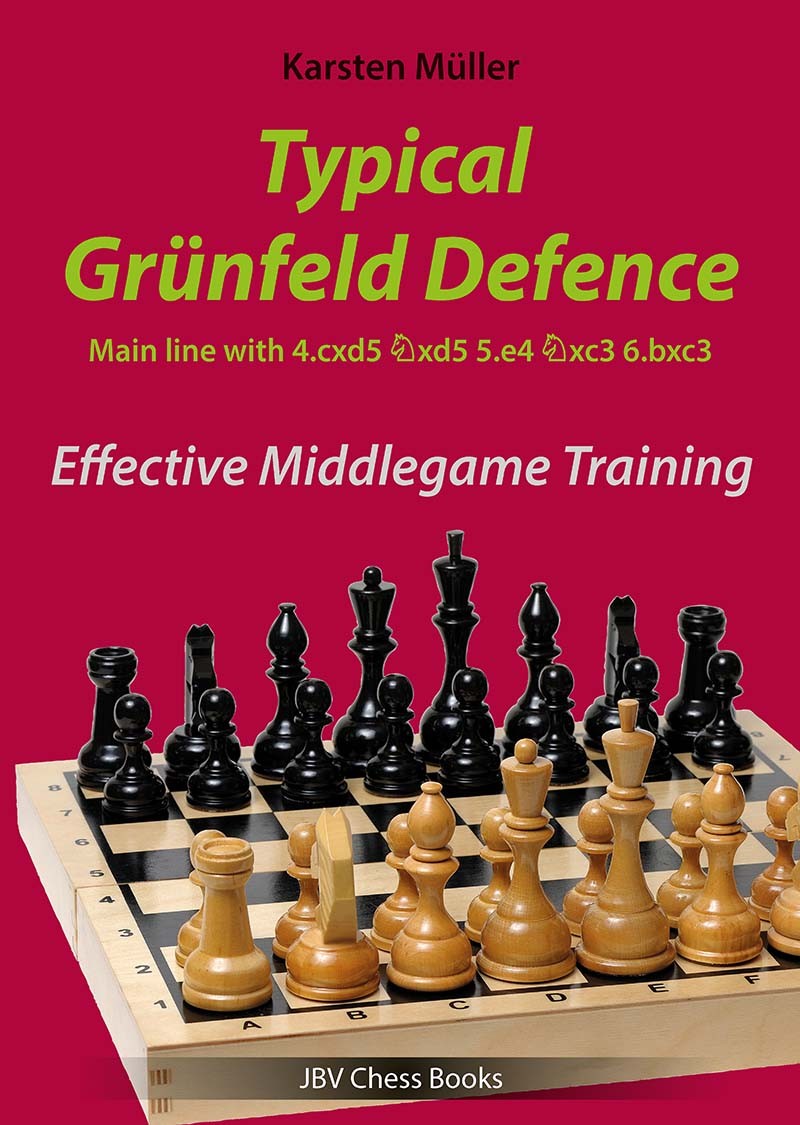
Müller: Typical Grünfeld Defence - Main line with 4.cxd5 Nxd5 5.e4 Nxc3 6. bxc3
In designing this book, the author was guided by the following considerations. If you want to learn this or that opening, you can choose from dozens or even hundreds of textbooks. But what if you want to get familiar with the middlegame strategy used in positions that have emerged from exactly this or that opening? Or to put it another way: in positions that are typical for this or that opening. Of course, in every middlegame textbook there's one or the other position that clearly comes from this or that opening. However, their number is negligible in the context of example positions from all the other openings whose middle- game treatment the reader doesn't want to learn at all. For example, aren't the issues of hanging pawns and minority attack – the author asks with good reason – just as dispensable for an e4 player as they are essential for a d4 player? – Why should a die-hard enthusiast of Indian openings care about the strategic intricacies of positions resulting from all those complicated Queen's Gambit systems? And of course vice versa: what use are all these subtleties of Indian positions to a player who by nature avoids fianchetto openings? And it's precisely this conspicuous and astounding vacuum in the area of middlegame literature that inspired the author to make an appropriate attempt at improvement: If you want to learn typical middlegame strategy for the Grünfeld Defence, you will get a textbook and exercise book that deals exclusively with Grünfeld Indian middlegames. However, this volume initially focuses only on the main line 1.d4 Nf6 2. c4 g6 3.Nc3 d5 4.cxd5 Nxd5 5.e4 Nxc3 6.bxc3 – or those positions that can arise from this basic structure, as shown in detail in the overview following the preface. It deserves special mention that the 100 exercises have been assigned to specific topics for the benefit of entertaining diversity – for example, candidates, the relegation candidate, the only move, and the like. 172 Seiten, kartoniert Joachim Beyer Verlag
24,80 €*

Müller: Typical King`s Indian
In designing this book, the author was guided by the following considerations. If you want to learn this or that opening, you can choose from dozens or even hundreds of textbooks. But what if you want to get familiar with the middlegame strategy used in positions that have emerged from exactly this or that opening? Or to put it another way: in positions that are typical for this or that opening. Of course, in every middlegame textbook there's one or the other position that clearly comes from this or that opening. However, their number is negligible in the context of example positions from all the other openings whose middlegame treatment the reader doesn't want to learn at all. For example, aren't the issues of hanging pawns and minority attack – the author asks with good reason – just as dispensable for an e4 player as they are essential for a d4 player? – Why should a die-hard enthusiast of Indian openings care about the strategic intricacies of positions resulting from all those complicated Queen's Gambit systems? And of course vice versa: what use are all these subtleties of Indian positions to a player who by nature avoids fianchetto openings? And it's precisely this conspicuous and astounding vacuum in the area of middlegame literature that inspired the author to make an appropriate attempt at improvement: If you want to learn typical King's Indian middle game strategy, you will get a textbook and exercise book in which only King's Indian is played. However, this volume only deals with positions in which Black attacks the white pawns on c4, d4 and e4 with the central push e7-e5 (and not c7-c5) – or those positions that can arise from this basic structure, as shown in detail in the overview following the preface. It deserves special mention that the 100 exercises have been assigned to specific topics for the benefit of entertaining diversity – for example the relegation candidate, the only move, violence or pressure increase and the like. 166 Seiten, kartoniert, Joachim Beyer Verlag
23,00 €*

Müller: Typical Ruy Lopez
In designing this book, the author was guided by the following considerations. If you want to learn this or that opening, you can choose from dozens or even hundreds of textbooks. But what if you want to get familiar with the middlegame strategy used in positions that have emerged from exactly this or that opening? Or to put it another way: in positions that are typical for this or that opening. Of course, in every middlegame textbook there's one or the other position that clearly comes from this or that opening. However, their number is negligible in the context of example positions from all the other openings whose middlegame treatment the reader doesn't want to learn at all. For example, aren't the issues of hanging pawns and minority attack - the author asks with good reason – just as dispensable for an e4 player as they are essential for a d4 player? – Why should a die-hard enthusiast of Indian openings care about the strategic intricacies of positions resulting from all those complicated Queen's Gambit systems? And of course vice versa: what use are all these subtleties of Indian positions to a player who by nature avoids fianchetto openings? And it's precisely this conspicuous and astounding vacuum in the area of middlegame literature that inspired the author to make an appropriate attempt at improvement: If you want to learn typical middlegame strategy of the Ruy Lopez, you will get a textbook and exercise book in which only Ruy Lopez middlegames are treated. However, this book only deals with positions in which the white pawns on c3, d4 and e4 are opposed by black pawns on e5 and d6 – or those positions that can arise from this basic structure, as shown in detail in the overview following the preface. It deserves special mention that the more than 100 exercises have been assigned to specific topics for the benefit of entertaining diversity – for example the relegation candidate, the only move, violence or pressure increase and the like. 182 Seiten, kartoniert Joachim Beyer Verlag
23,00 €*

Müller: Typical French
In designing this book, the author was guided by the following considerations. If you want to learn this or that opening, you can choose from dozens or even hundreds of textbooks. But what if you want to get familiar with the middlegame strategy used in positions that have emerged from exactly this or that opening? Or to put it another way: in positions that are typical for this or that opening. Of course, in every middlegame textbook there's one or the other position that clearly comes from this or that opening. However, their number is negligible in the context of example positions from all the other openings whose middlegame treatment the reader doesn't want to learn at all. For example, aren't the issues of hanging pawns and minority attack – the author asks with good reason – just as dispensable for an e4 player as they are essential for a d4 player? – Why should a die-hard enthusiast of Indian openings care about the strategic intricacies of positions resulting from all those complicated Queen's Gambit systems? And of course vice versa: what use are all these subtleties of Indian positions to a player who 'by nature' avoids fianchetto openings? And it's precisely this conspicuous and astounding vacuum in the area of middlegame literature that inspired the author to make an appropriate attempt at improvement: If you want to learn French middlegame strategy, you will get a textbook and exercise book in which only French middlegames are treated. However, this book only deals with positions in which the white pawns on d4 and e5 are opposed by black pawns on d5 and e6 – or those positions that can arise from this basic structure, as shown in detail in the overview following the preface. It deserves special mention that the 110 exercises have been assigned to specific topics for the benefit of entertaining diversity – for example 'the top candidate', 'the relegation candidate', 'the only move', 'violence or pressure increase' but also 'joke articles' and the like. 184 Seiten, kartoniert, Joachim Beyer Verlag
23,00 €*

Müller: Typical Queen´s Gambit - Exchange Variation
In designing this book, the author was guided by the following considerations. If you want to learn this or that opening, you can choose from dozens or even hundreds of textbooks. But what if you want to get familiar with the middlegame strategy used in positions that have emerged from exactly this or that opening? Or to put it another way: in positions that are typical for this or that opening. Of course, in every middlegame textbook there's one or the other position that clearly comes from this or that opening. However, their number is negligible in the context of example positions from all the other openings whose middlegame treatment the reader doesn't want to learn at all. For example, aren't the issues of hanging pawns and minority attack – the author asks with good reason – just as dispensable for an e4 player as they are essential for a d4 player? – Why should a die-hard enthusiast of Indian openings care about the strategic intricacies of positions resulting from all those complicated Queen's Gambit systems? And of course vice versa: what use are all these subtleties of Indian positions to a player who 'by nature' avoids fianchetto openings? And it's precisely this conspicuous and astounding vacuum in the area of middlegame literature that inspired the author to make an appropriate attempt at improvement: If you want to learn Sicilian middlegame strategy, you will get a textbook and exercise book in which only Sicilians are treated. However, this book only deals with the Queen's Gambit – more precisely: the Exchange Variation with white pawns on e3 and d4 against black pawns on c6 and d5 – the so-called 'Carlsbad structure'. It deserves special mention that the 120 exercises have been assigned to specific topics for the benefit of entertaining diversity – for example 'the relegation candidate', 'the only move', 'violence or pressure increase' and the like. 178 Seiten, kartoniert, Joachim Beyer Verlag
23,00 €*

Müller: Typical Queen´s Gambit - Orthodox Variation
In designing this book, the author was guided by the following considerations. If you want to learn this or that opening, you can choose from dozens or even hundreds of textbooks. But what if you want to get familiar with the middlegame strategy used in positions that have emerged from exactly this or that opening? Or to put it another way: in positions that are typical for this or that opening. Of course, in every middlegame textbook there's one or the other position that clearly comes from this or that opening. However, their number is negligible in the context of example positions from all the other openings whose middlegame treatment the reader doesn't want to learn at all. For example, aren't the issues of hanging pawns and minority attack – the author asks with good reason – just as dispensable for an e4 player as they are essential for a d4 player? – Why should a die-hard enthusiast of Indian openings care about the strategic intricacies of positions resulting from all those complicated Queen's Gambit systems? And of course vice versa: what use are all these subtleties of Indian positions to a player who 'by nature' avoids fianchetto openings? And it's precisely this conspicuous and astounding vacuum in the area of middlegame literature that inspired the author to make an appropriate attempt at improvement: If you want to learn French (the opening, mind you, and not the language!), you will get a textbook and exercise book in which only French is 'spoken' or played. However, this book deals exclusively with the Orthodox Queen's Gambit (1.d4 d5 2.c4 e6) – or, more precisely, with positions that can arise from this basic structure. It deserves special mention that the more than 100 exercises have been assigned to specific topics for the benefit of entertaining diversity – for example 'relegation candidate', 'only move', 'violence or pressure increase' and the like. 178 Seiten, kartoniert, Joachim Beyer Verlag
23,00 €*

Müller: Typical Sicilian
In designing this book, the author was guided by the following considerations. If you want to learn this or that opening, you can choose from dozens or even hundreds of textbooks. But what if you want to get familiar with the middlegame strategy used in positions that have emerged from exactly this or that opening? Or to put it another way: in positions that are typical for this or that opening. Of course, in every middlegame textbook there's one or the other position that clearly comes from this or that opening. However, their number is negligible in the context of example positions from all the other openings whose middlegame treatment the reader doesn't want to learn at all. For example, aren't the issues of hanging pawns and minority attack – the author asks with good reason – just as dispensable for an e4 player as they are essential for a d4 player? – Why should a die-hard enthusiast of Indian openings care about the strategic intricacies of positions resulting from all those complicated Queen's Gambit systems? And of course vice versa: what use are all these subtleties of Indian positions to a player who 'by nature' avoids fianchetto openings? And it's precisely this conspicuous and astounding vacuum in the area of middlegame literature that inspired the author to make a appropriate attempt at improvement: If you want to learn Sicilian middlegame strategy, you will get a textbook and exercise book in which only Sicilians are treated. However, this current book only deals with the type 'Open Sicilian'. More precisely: with positions characterized by the 'small center' consisting of the pawns on d6 and e6, which is typical for the vast majority of Sicilian systems. It deserves special mention that the more than 150 exercises have been assigned to specific topics for the benefit of entertaining diversity - for example 'the relegation candidate', 'the only move', 'violence or pressure increase' and the like. 160 Seiten, kartoniert, Joachim Beyer Verlag
23,00 €*
Tipp

Müller & Konikowski: The best Combinations of the World Champions Vol 1 - from Steinitz to Tal
Since every world champion was the most outstanding player of his time, it makes sense to study the various aspects of the royal game using the world champions' games – and of course to enjoy them. In this first of two volumes on the world champions' art of combination, the authors (both recognized experts in the field of chess literature) offer the reader the opportunity of trying to find plenty of these best combinations themselves – and thus to assess and improve their own tactical skills. But that's not all. In addition to often breathtakingly spectacular sample games, which are thoroughly analyzed and commented on in a comprehensible way, individual pet topics are highlighted in which the world champions have created particularly outstanding works. So you are invited to take a closer look at how Steinitz handled the 'Steinitz King' – at Lasker's phenomenal art of defense and Capablanca's mastery of 'small combinations' (for which the French term 'petite combinaison' has become common in chess language). Furthermore, at Alekhine's dashing attacks, at Euwe's seventh sense for dynamic transformations, Botvinnik's tactical solutions to strategic problems, Smyslov's virtuosity even in tactical endgames and – last but not least – at Tal's downright magical tactical works of art with which he not only bewitched his opponents, but the entire chess world. Thanks to the QR-codes above the diagrams, you can download the position directly to your smartphone and watch or analyze the game, so that the laborious and error-prone input by hand is no longer necessary. Volume 1 contains 260 combinations and many fully annotated sample games. 192 Seiten, kartoniert, Joachim Beyer Verlag
27,80 €*
Tipp

Müller & Konikowski: The best Combinations of the World Champions Vol 2 - from Petrosian to Carlsen
Since every world champion was the most outstanding player of his time, it makes sense to study the various aspects of the royal game using the world champions' games – and of course to enjoy them. In this first of two volumes on the world champions' art of combination, the authors (both recognized experts in the field of chess literature) offer the reader the opportunity of trying to find plenty of these best combinations themselves – and thus to assess and improve their own tactical skills. But that's not all. In addition to often breathtakingly spectacular sample games, which are thoroughly analyzed and commented on in a comprehensible way, individual pet topics are highlighted in which the world champions have created particularly outstanding works. So you are invited to take a closer look at Petrosian's deeply thought out exchange sacrifices, at Spassky's always tactically alert attacking skills and Fischer's often combinatorial exploitation of advantages in the endgame. Furthermore, at the tactical aspects of Karpov's dominance and restriction methods, Kasparov's dynamic pressure play, Kramnik's positional power play, Anand's fine sense for dynamics and – last but not least – Magnus Carlsen's combinatorial conversion of his excellent endgame strategy. Volume 2 contains 288 combinations and many fully annotated sample games. 240 Seiten, kartoniert, Joachim Beyer Verlag
27,80 €*

Aagaard: A Killer Guide to Attacking Chess
A Killer Guide to Attacking Chess provides an expert introduction to the main elements of good attacking chess. From the foundational concepts of Momentum and Include all the pieces in the attack, to more situational ideas such as Attacking the weakest square, Attacking the strongest square, Evolution/Revolution, the Killzone and much more. By breaking down attacking play into easily identifiable elements everyone can understand, we see that attacking play is not the result of a genius in action, but a consequence of positional factors at play. With this knowledge, and the chance to practise it with the sister volume Grandmaster Training Camp 2 – Attack! by GM Sam Shankland, true attacking greatness is within reach. Jacob Aagaard is one of the foremost chess authors in the world, and previously the trainer of GMs Abdusattorov, Gelfand, Shankland and more, helping many students to reach their full potential and career peaks. Not the least through his online academy killerchesstraining.com. 272 Seiten, kartoniert, Quality Chess
29,95 €*

Chen: The Thinker’s Game – Decoding the Chess Universe
This book is written for beginners who are interested in the game and would like to learn more about its various aspects. It covers the technical aspects of chess: the use of algebraic notation (Chapter 3), chess evaluation (Chapter 4), the opening phase (Chapter 5), the middle game (Chapter 6), the endgame (Chapter 7), and the chess rating system (Chapter 8). It introduces a number of chess problems, formulated with a chess board and chess pieces and presupposing a working knowledge of chess (Chapter 9). It offers an account of variants of chess such as Fischer random chess (Chapter 10). It also covers the cultural aspects of chess: its history (Chapter 2) and status as an immortal game that might enable it to play a role in the search for extraterrestrial intelligence (Chapter 11). Wherever possible, chess diagrams are provided to help chess beginners make sense of certain points about chess. Algebraic notation will also guide them in understanding certain chess-based lines of reasoning. Whenever you are ready, let us begin this odyssey of chess. “Chess is a fiercely competitive, strategic game – and so much more than that. Chess is history and a powerful metaphor with deep cultural meaning. Chess is a global language, which speaks to philosophy and education. In his new book, Melvin Chen provides a much-needed holistic view on our beloved ancient game.” GM Judit Polgar, August 2024. 168 Seiten, gebunden, Thinkers Publishing
38,95 €*

Edouard: Chess Calculation Training for Kids and Club Players Level 1 - Checkmating
In 2017, Romain Edouard launched a brand new series of exercise books, Chess Calculation Training. The series became one of the most popular tactics books amongst advanced players. This new series, Chess Calculation Training for Kids and Club Players, is based on the same model, but aimed at players of a more modest level. In this first volume, you can enjoy 276 chess problems, which arose in real games, and you should checkmate your opponent! The book is divided into eight chapters, starting with basic mates in two, and the difficulty of the exercises increases as you go through the book. It is a fantastic training tool for anyone wanting to improve his tactical skills quickly, and not miss any opportunity to end the game with a glorious checkmate! Romain Edouard, with a highest rating of 2702, has been part of the French national team since 2011. As a teenager, he won the gold medal in the European U16 Championship in 2006, and silver medals in the European and World U18 Championships in 2007. Having already written four books, Romain has earned the reputation of being an outstanding author. 152 Seiten, kartoniert, Verlag Thinkers Publishing
21,95 €*

Emms: Simple Chess
Its been said many times before that chess is an easy game to learn, but a difficult one to master. The game is full of difficult questions such as, What do you do when your opponent is skilful enough to prevent both checkmate and material loss? However, once the principal strategic ideas are recognised, then everything becomes much clearer and the game becomes much simpler. In this book Grandmaster and experienced chess writer John Emms provides the reader with the fundamental knowledge required to enter every game with confidence. 144 Seiten, kartoniert, Verlag Everyman, 2001
23,40 €*

Ernst & van Delft: Find Your Next Move (HC)
Candidate Moves and Thinking Tools in Chess The candidate move is perhaps the most elusive concept in chess theory. First introduced by Alexander Kotov in his famous book Think Like a Grandmaster, it seems clear and methodical enough: when considering a move, you make a list of "candidates" in your mind, compare their merits, and make your choice. But how do you determine what a candidate move is, and how do you proceed from there? The candidate move is perhaps the most elusive concept in chess theory. First introduced by Alexander Kotov in his famous book Think Like a Grandmaster, it seems clear and methodical enough: when considering a move, you make a list of "candidates" in your mind, compare their merits, and make your choice. But how do you determine what a candidate move is, and how do you proceed from there? In this book, based on a Chessable course, chess grandmaster Sipke Ernst and chess psychologist Karel van Delft address these questions. First, Ernst offers a practical approach with many original game fragments, divided into four parts with 30 chapters. By studying these fragments the reader becomes familiar with methods such as comparing and eliminating candidate moves, as well as positional methods like prophylaxis and even psychological weapons. In the fifth part, Van Delft presents thirty thinking tools for finding the best candidate moves. This comprehensive collection of tools is the result of intensive research as well as practical experience during years of youth training. They will help the reader increase their understanding and memory, and develop effective routines and skills. Reading this book will be a great boost to your decision-making in chess! Sipke Ernst (1979) is a seasoned chess grandmaster and FIDE trainer who has been a member of the Dutch national team. His peak Elo rating is 2606. Karel van Delft (1956) is a psychologist and a former science project manager with Chessable. He is the author of the book Chess For Educators (New In Chess, 2021) and runs the Apeldoorn Chess Academy in The Netherlands. In 2022, The University of Texas at Dallas Chess Program selected Van Delft as its Chess Educator of the Year. 288 Seiten, gebunden, Verlag New in Chess
29,95 €*

Gelenczei: The Little Book Of Chess Blindness
We chess players, are all victims of a previously unidentified bacillus (bacilli scachistica) which suddenly and viciously strikes its unsuspecting victim. It is the 'amaurosis scachistica pernicosa' which Dr. Tarrasch diagnosed nearly a hundred years ago; the debilitating illness of chess blindness so frequent nowadays. And in this book the author attempts to find the psychological motive, too, behind it. The original, Hungarian title, Így sakkoztok ti (This Is How You Play Chess), is connected with an old anecdote: Soldiers are being taught to shoot at a target under the leadership of a corporal. They are not doing too well. The corporal scolds his recruits angrily, and when one of them misses the mark again, he snatches the gun from his hand, shouting: Asses! You don´t know anything about shooting! Give me that gun! Look! He takes aim, and, perkily, shoots. But he misses. He gets confused for a moment, and then snaps at one of the soldiers: This is how you shoot! He takes aim again. Another miss. He turns to another soldier: This is how you shoot! And so forth. Finally, at the ninth try, he hits the mark. Tapping his chest, he says: And this is how I shoot! 120 Seiten, kartoniert, Caissa Chess Books
14,80 €*

Grivas: The Passed Pawn
A passed pawn must be blockaded, so as to have its power restrained as much as possible. The minor pieces (knight or bishop) are ideal for this purpose, as they can rarely be forced to retreat by enemy action. On the other hand, the major pieces (queen and rook) find it difficult to achieve a stable blockade as is easy to harass them, while one must also consider that, for such valuable pieces, dealing with a mere pawn cannot be an efficient form of employment. Taking the above into account, it becomes clear that the side with the passed pawn should seek to exchange minor pieces and retain the major ones; the opposite applies to the defending side.” 240 Seiten, kartoniert, Verlag Thinkers Publishing
29,95 €*
Neu

Hellsten: Mastering Chess Defence
All chess players know that they need to study tactics, calculation, endgames, and openings, but when it comes to defense, far too many wait until they're under pressure. The truth is that more games are lost because of defensive mistakes than strategic ones. By improving your defense, you could do more for your win rate than perhaps any other area of chess study. Mastering Chess Defence by GM Johan Hellsten is the training program you need to be prepared and defend against attacks, both in the short and long term. Inside are 31 chapters that form a compendium of all the defensive skills you need to learn. Specifically, you'll learn to Deflect successfully with material Create counterthreats - the best defense is a good offense Exploit the back rank as a defensive measure Learn the risks of materialism - to grab material or not to grab? Find safety on flight squares Find "lifelines" that allow you to escape from the seemingly inescapable This is the most comprehensive modern book on defensive techniques, with hundreds of instructive examples and dozens of exercises. Strategic mastermind Johan Hellsten teaches you to defend at a master level. Johan Hellsten is a Grandmaster, a former Swedish Champion and a European Team Championship individual gold medalist. He's a renowned chess teacher and award-winning author with his trilogy: Mastering Chess Strategy, Mastering Opening Strategy and Mastering Endgame Strategy. 464 Seiten, gebunden, Verlag New in Chess
37,95 €*

Juhasz: Sharpen up your chess- Boost your chess results
The clarity, simplicity, and pure instructiveness of this book is striking. The analysis is first rate, the commentary cogent, and the production excellent. The emphasis is on general principles that readers will be able to use in their own games. The key is to always stay ahead of your opponent and know how to control the chaos on the chess board. Armin Juhasz explains all this in detail without losing sight of practical decision making. With the right strategies, anyone can become a champion and level up their game to become unstoppable. This book is for the ambitious and keen player! The emphasis is on general principles that readers will be able to use in their own games, and detailed analysis is always given where it is necessary. Each game and fragment contain many lessons and practical tips, guiding the reader through the most important ideas in each phase of the game. This book illustrates an increasingly prevalent and successful style of play, a method that begins by slowly accumulating small but permanent advantages. The author does a very good job of explaining the key points of the game in such a way that the reader is given a true account of what is happening and not some watered down version. Translating the muddy world of modern master chess into something that is understandable to the layman, is a skill Armin mastered. 378 Seiten, gebunden, Verlag Thinkers Publishing
44,95 €*

Kuljasevic: Beyond Material
In order to win a game of chess you very often have to sacrifice material. Gathering the courage to do so while accurately assessing the potential benefits is a real challenge. The big question is always: what’s my compensation? Generations of chess players grew up with the idea that a sacrifice was correct if the material was swiftly returned, with interest. Almost by reflex, they spent lots of time counting, quantifying the static value of their pieces. But is that really the best way to determine the correctness of a sacrifice? In this book, Grandmaster Davorin Kuljasevic teaches you how to look beyond the material balance when you evaluate positions. With loads of instructive examples he shows how the actual value of your pieces fluctuates during the game, depending on many non-material factors. Some of those factors are space-related, such as mobility, harmony, outposts, structures, files and diagonals. Other factors are related to time, and to the way the moves unfold: tempo, initiative, a threat, an attack. Modern chess players need to be able to suppress their need for immediate gratification. In order to gain the upper hand you often have to live with uncertain compensation. With many fascinating examples, Kuljasevic teaches you the essential skill of taking calculated risks. After studying Beyond Material, winning games by sacrificing material will become second nature to you. Davorin Kuljasevic is an International Grandmaster born in Croatia. He graduated from Texas Tech University and played in USCL 2007 and 2008 for Dallas Destiny, the team that became US champion in both these years. He is an experienced coach and a winner of many tournaments. 336 Seiten, kartoniert, Verlag New In Chess
22,95 €*
Neu

Maatman: The Hidden Laws of Chess - Mastering Pawn Structures
Have you ever wondered why strong chess players immediately grasp what is happening in complex positions? The secret is pawn structures. The pawn structure dictates the game's flow, and different structures require distinct approaches. You can improve your game by studying a large variety of pawn structures and the Hidden Laws of Chess. IM Nick Maatman invented the Hidden Laws of Chess as an instructional tool to help his students bridge the gap between the basic understanding of a club player and the next level of knowledge of Masters and Grandmasters. A grandmaster knows from experience what pieces to exchange when facing an isolated pawn, while a club player wonders if he should keep his rooks on the board - or not. The Hidden laws go one level deeper than the basic laws on piece development, king safety or material balance. The Hidden Laws will uncover elements such as space, the quality of a pawn structure, and a doubled pawn's strength or weakness. Maatman will answer questions like: Are backward pawns the worst in chess? What is the value of a space advantage? Could doubled pawns be an asset? How can I win symmetrical positions? Using his coaching experience and writing with a touch of science and philosophy, Maatman will guide any ambitious chess player to the next level. His book contains dozens of actionable tips, instructive games and carefully selected exercises. Nick Maatman (1995) is an International Master, experienced chess coach, and training partner of Super-GM Jorden van Foreest. Maatman has won the Dutch U20 Championship and has beaten many strong grandmasters in tournament games. The Hidden Laws of Chess is his first book, but he expects many more to follow. He graduated from Groningen University in both Business and Philosophy. 256 Seiten, gebunden, Verlag New in Chess
33,95 €*

Mohr: The Exchange Sacrifice Unleashed
The book you have started reading explains the concept of the exchange sacrifice in chess. It is a complex concept where the value of pieces is not determined solely by their numerical value but also by the potential strategic advantage they provide. Beginners are taught the value of pieces using pawns as a unit of measurement, but as players progress, they begin to understand that a material advantage is not always a guarantee of winning. The sacrifice of an exchange, where a player gives up a rook for a bishop and a knight or a pawn, can lead to a strategic advantage. However, many players are hesitant to make this sacrifice due to the fear of losing a material advantage and ending up in a fatal endgame situation. The book explores the psychology behind this fear and offers guidance on how to overcome it. The book also covers the increasing use of exchange sacrifice as a tactical and strategic element in modern games. The author delves into the reasons behind this trend and discusses several open questions related to the exchange sacrifice. By shedding light on this complex concept across many chapters, the book offers a comprehensive understanding of the exchange sacrifice and its importance in chess strategy. 015 Introduction 027 Chaper I - The Exchange Sacrifice for the Attack 061 Chapter II - Defence! 097 Chapter III - Ending 125 Chapter IV - Exchange Sacrifice in the Opening 187 Chapter V - Critical Squares 251 Chapter VI - The Positional Exchange Sacrifice 447 Chapter VII - World Champions and the Exchange Sacrifice • Compensation is a chess concept that we only fully understand when we enter the world of serious chess. • The relative value of pieces is perhaps the most difficult chess concept of all to explain. • It is one that every player must feel and believe in and can only be accepted with the help of our own practice, and when we feel it come together as though a part of us. • Why so much talk about such or similar sacrifices? Quite simply because we are afraid! We have been taught, and practice shows and proves the clear fact, that the closer we get to the last part of the game, the ending, the more pronounced a material advantage becomes. • If in the middlegame we can still hope for sudden turns, for the influence of other pieces, this is negligible in the endgame. • Maybe less so with tactical sacrifices, where we immediately see what the sacrificer gets in return. • How can we not accept the rook that the opponent offers us, when there is nothing concrete to see? One or two weaknesses perhaps, but they can be eliminated, and the material advantage and a secure victory in the endgame remains. 496 Seiten, gebunden, Thinkers Publishing
44,95 €*

Nestorovic & Nestorovic: Positional Sacrifices in Modern Chess
A Word from the Authors The sequel, or the second part of the Secrets of Positional Sacrifice manual is titled Positional Sacrifice in Modern Chess. We assume that readers will conclude that the subject of our analysis are recently played games, especially the games played over the last few years. The book is intended for chess players who aspire to raise the level of positional play in this particular field of expertise, as well as coaches working on chess education. Like the previous book Secrets of Positional Sacrifice, the book in our hands is divided into chapters according to the material that is the subject of the sacrifice: the positional sacrifice of a pawn, exchange, piece, rook, and queen. Finally, the last chapter deals with “hot games” and contains six games played during November and December 2021. We believe that the book is as interesting and instructive as its prequel. However, the examples are a tad more complicated, primarily because of the positional rook sacrifice section. In actual fact, the examples on this kind were very difficult to find in practice, and processing them in the right way was a particular challenge for us. The first section, the positional pawn sacrifice, should encourage the reader to execute one of the most complicated positional sacrifices in practice as often as possible. On the other hand, the sacrifice of exchange is the most common and easiest to apply and can very successfully serve as a means of relieving the fear of possible sacrifice of material. Asymmetric positions, i.e., positions with an unusual distribution of material, are mostly featured in the positional piece and queen sacrifice positions. In the last chapter entitled “Hot Games,” we present the analysis on the topics of various fascinating examples, from the latest games of today’s great players. We tried to choose the examples that were easy to follow, so they are embellished with diagrams and explained verbally as well. We paid more attention to the analysis of the positional sacrifice from the moment of its execution to the end of the game. Hence, the introductory part of each example may be somewhat shorter in relation to the first book. Finally, the invaluable exercises at the end of the book should be mentioned. The tasks cover four topics to make them as interesting and easy to solve as possible. The exercises are based on the correct assessment of asymmetric positions and, of course, on concrete calculations. In conclusion, we would like to emphasize that the book highlights the beauty of human ideas and their practical application. In some cases, the authors give preference to the human idea over the assessment of the computer. When a player cannot calculate complicated lines accurately, he should look for an alternative solution of the similar quality. One of the possible answers is the positional sacrifice that leads to asymmetric material and thus the change of the character of the fight. GM Nikola Nestorovic IM Dejan Nestorovic 312 Seiten, gebunden, Chess Informant
34,95 €*

Okhotnik: The Modernized Barry Attack
• The Barry Attack is a little rebellious but most dynamic opening • It’s one of the fastest ways to outplay your opponent in the opening. • The ‘’super repertoire’’ that always keeps Black under pressure in all variations. • Any reasonable opening set-up can work wonders for White or Black if they know it well. • Anyone who takes the trouble to play through each model example, move by move, note by note, will be rewarded. • Your strategic play will deepen and your tactics will improve along with your assessment skills, and you’ll end up with a great repertoire! Description The Barry Attack is somewhat defensive-looking from the start. It tempts Black forward, provocatively. The Barry Attack is, after all, a little rebellious, flouting, as it does, all those common sense development rules. Perhaps your game needs a good shot of tactics to boost your results – it’s one of the fastest ways to improve and this is true not only for young players. If your opponent plays an early move order that’s not in this book such as 1. d4 Nf6 2. Nf3 g6 3. c4 or 1. d4 Nf6 2. Nf3 g6 3. Nc3 Bg7 for example, the good news is that black will be forced to transform back into the material. The ‘’super repertoire’’ that always keeps Black under pressure in all variations is of course, a total myth. Any reasonable opening set-up can work wonders for White or Black if they know it well. This is always going to outweigh theoretical evolution. Playing strong chess is also very much about your level of self-confidence, emotional and physical health. It’s about who you are and how you feel in many ways at the precise moment of play in addition to your opening knowledge and general technique. Anyone who takes the trouble to play through each model example, move by move, note by note, will be rewarded. Your strategic play will deepen and your tactics will improve along with your assessment skills, and you’ll end up with a great repertoire!204 Seiten, gebunden,Thinkers Publishing
34,95 €*